
Tractor vs Dump Truck vs Semi-Trailer: Heavy Duty Vehicle Basics Explained
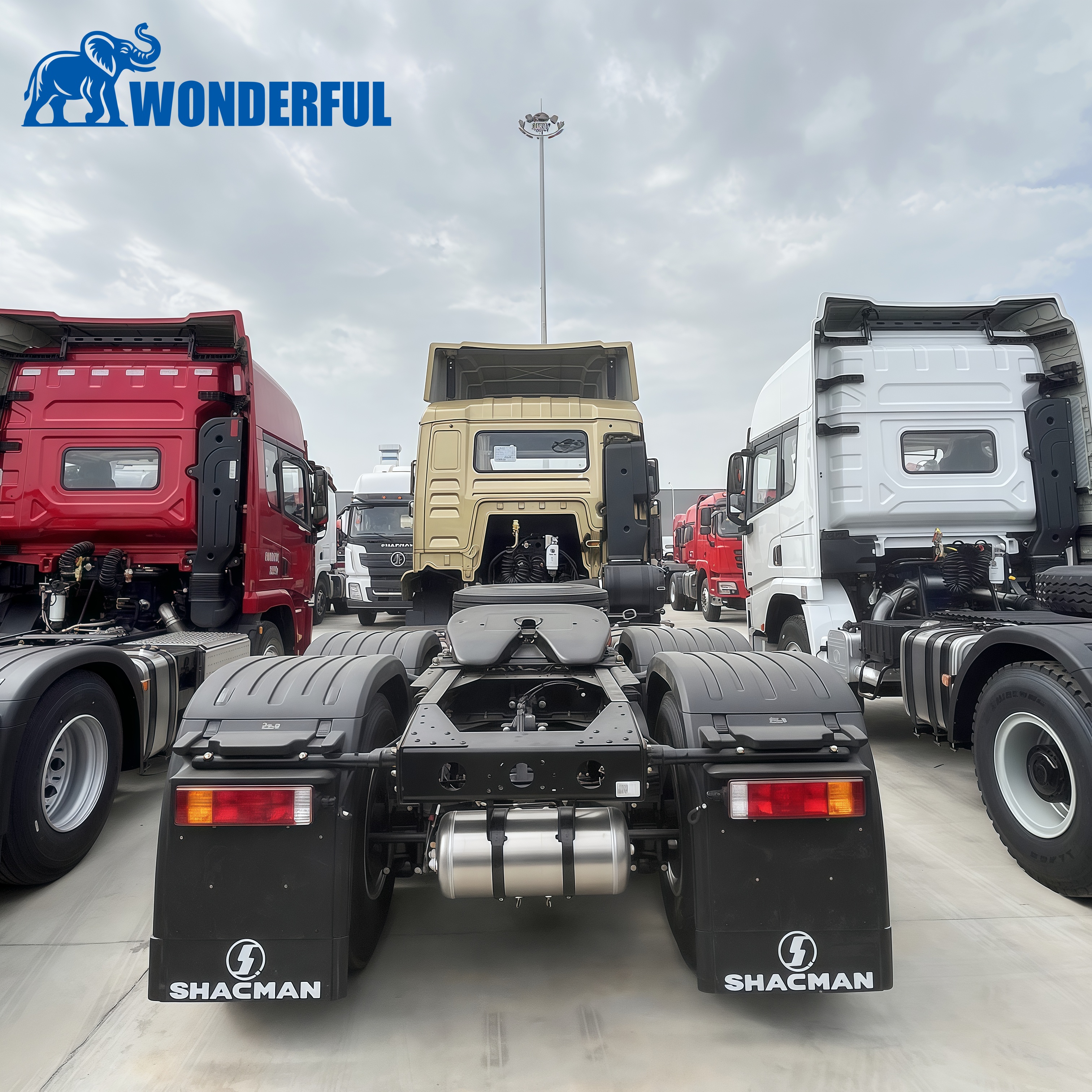
Short answer: a tractor truck is a towing unit. It has a cab, an engine and a coupling, but no cargo body of its own, so it only works when it is hitched to a semi-trailer. A dump truck carries its own cargo body on a rigid chassis and discharges the load with a hydraulic lift cylinder. A semi-trailer is the cargo unit itself: no engine, no cab, and no way to move until a tractor truck pulls it.
Those three sentences resolve the question most newcomers to commercial trucking ask first: why do some heavy duty trucks look like a truck plus a trailer, while others are one solid box on wheels? The confusion is normal, because the industry sells all of them under the same umbrella term, and because the chassis underneath a tractor truck and a dump truck can look remarkably similar from the outside.
The category is large. The global heavy-duty trucks market was estimated at USD 308.3 billion in 2025 and is projected to reach USD 475.5 billion by 2035 (Global Market Insights). Estimates vary by scope — Dataintelo puts 2025 at USD 212.4 billion and Market Research Future at USD 234.1 billion — largely because some studies count only Class 8 tractors while others cover the wider Class 4–8 range. The terminology problem, however, is identical in every market and every price band.
Problem Definition: Why the Three Categories Get Mixed Up
The word "truck" hides two completely different purchase decisions. One is a decision about a self-propelled vehicle. The other is a decision about a combination of two units that only works together.
Four mistakes appear again and again when buyers are still in the awareness and research stage:
- Treating a semi-trailer as a standalone vehicle. A semi-trailer has no drivetrain and no cab, so it cannot be deployed independently. It requires a tractor truck with a compatible coupling.
- Buying a tractor truck for a job that needs a tipping body. If the material has to be discharged on site — quarry spoil, aggregates, construction debris — the vehicle needs its own hydraulic lift system, not a fifth-wheel coupling.
- Comparing cargo body dimensions across vehicle classes. The cargo body of a dump truck is a fixed steel box with a defined length, width and height. A semi-trailer is a separate unit with its own footprint. The two are not interchangeable measurements.
- Assuming all heavy duty trucks sit at the same emission tier. Within a single product range, one model can be EURO 5 and another EURO II. The tier depends on the model and the market it was specified for, not on the vehicle class.
A buyer who can answer one question — does the load sit inside the load-carrying vehicle, or inside a separate unit towed behind it? — has already solved most of the problem.
Industry Background: Rigid Trucks and Articulated Combinations
Commercial haulage is built on two structural families.
Rigid trucks carry the cargo body on the same chassis that carries the cab and engine. Dump trucks, cargo trucks and tanker trucks belong to this family. The vehicle is a single, complete unit that can be dispatched on its own.
Articulated combinations — also described as articulated heavy duty trucks or tractor-trailer units — split the job between a self-propelled tractor truck and a non-powered semi-trailer. This is the standard architecture for long haul heavy duty truck work, because the payload unit can be swapped without taking the tractor out of service.
The supply side of this market has shifted significantly. China's heavy duty truck exports reached 276,000 units in 2023, a 58% year-on-year increase, and rose to 295,000 units in 2024 (Shacman industry report / CAAM). In the first half of 2024, China's total truck exports reached 351,000 units, with roughly one out of every three heavy trucks seen overseas originating from China (China Association of Automobile Manufacturers). For buyers in Africa, Southeast Asia and other emerging markets, this means Chinese-built chassis are now a normal part of the sourcing shortlist rather than an alternative.
Electrification is the second structural shift. The global electric heavy duty truck market is projected to grow from USD 14.84 billion in 2026 to USD 101.02 billion by 2034 (Fortune Business Insights), and heavy-duty electric truck penetration in China is forecast to exceed 20% in 2026, driven by subsidy-led replacement and charging infrastructure growth (S&P Global Ratings). Diesel heavy duty trucks remain the practical default for long-distance and off-road work in most export markets, but the vehicle classification logic — rigid versus articulated — does not change when the powertrain does.
On the manufacturing side, the market remains concentrated at the top: Daimler Truck led the global market with a share of over 12% in 2025, and the top five players (Daimler, PACCAR, Sinotruk, TRATON and Volvo) held 32% collectively (Global Market Insights). Below that tier sits a large group of regional specialists that supply chassis and trailers into specific corridors, including Africa.
Rule of thumb: if the cargo can be detached from the powered vehicle, you are looking at an articulated combination. If the cargo cannot leave the vehicle without the vehicle being tipped, you are looking at a rigid truck such as a dump truck.
The Three Vehicle Types in Plain Terms
1. Tractor Truck: The Towing Unit

A tractor truck — sometimes called a tractor unit, prime mover or towing heavy duty truck — is the powered half of an articulated combination. It carries the engine, the cab, the transmission and the driven axles, and it ends at the coupling rather than at a cargo box.
A concrete example from the SHACMAN range is the SHACMAN F3000 (product reference 6772), classified as a tractor truck and intended for heavy-duty transport scenarios. Its verified configuration is:
- Drive type: 6x4
- Engine: WP10.340E22, 340 HP
- Emission tier: EURO II
- Gearbox: 10JSD180 manual gearbox
- Cab: medium-length flat roof cab without top guide cover
- Material: steel
- Intended industries: logistics, agriculture, mining, engineering and manufacturing
What this means for a buyer: the F3000 does not deliver cargo on its own. It delivers motion. The value of the specification sits in the engine, gearbox and drive configuration, because those determine what the vehicle can pull and over what terrain. When a fleet specifies a towing heavy duty truck, the trailer it will pull is part of the same decision, not a separate purchase made later.
2. Dump Truck: The Cargo Body Is Part of the Vehicle
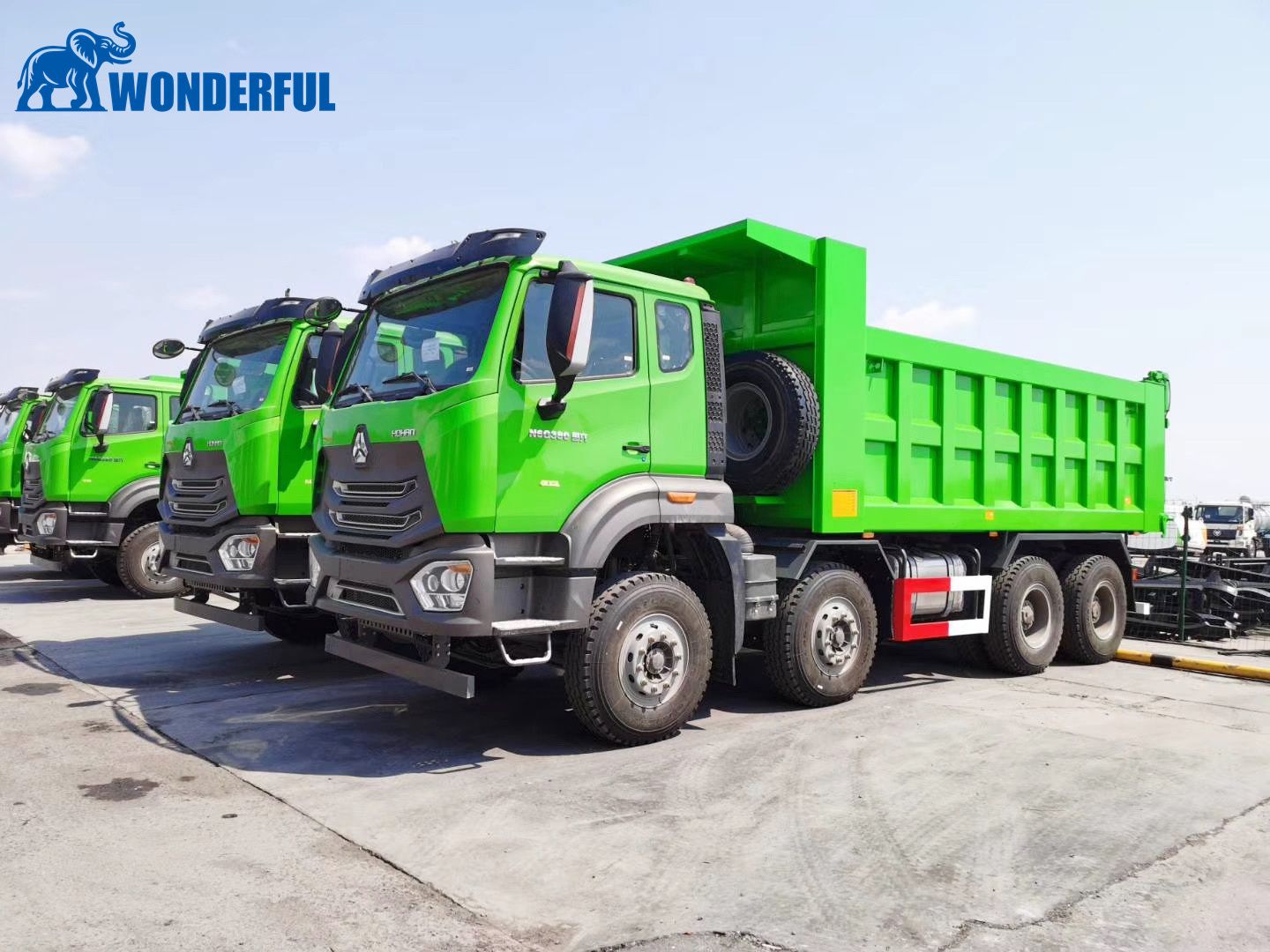
A dump truck is a rigid heavy duty truck whose cargo body is mounted permanently on the chassis. Discharge is mechanical: a hydraulic cylinder lifts the body and the material slides out under gravity. There is no fifth wheel and no towing unit, which is why dump trucks dominate construction and mining haulage — the vehicle can arrive loaded and leave empty without any auxiliary equipment.
Two dump truck examples with different specification profiles show how much the details vary inside one vehicle class.
SINOTRUK 6x4 Dump Truck ZZ3257N384GB1R is built around a WD615.47 diesel engine producing 371 hp, paired with an HW19710 gearbox and an HW50 direct-connection power take-off unit that drives the tipping hydraulics. The front axle is a VGD95 with drum brake, the rear axles are MCP16ZG dual rear axles with a 5.45 gear ratio, and the suspension uses reinforced multi-leaf springs at both ends. The cargo body measures 5,600 × 2,300 × 1,500 mm with an 8 mm bottom and 6 mm sides in Q355 manganese plate, formed as a rectangular container. The frame is a double-layer 8+8/300 mm structure, the fuel tank holds 400 L, and the tyres are 12.00R20 with a mixed tread pattern at 18PR. Overall construction uses carbon steel and SS304 stainless steel.
SHACMAN X3000 6×4 Dump Truck (model SX3258W384C) takes a different route. It is powered by a CUMMINS ISM11E5 440 engine rated at 324 kW / 440 HP and meeting EURO 5 emission standards, with a 12JSD200T-B transmission including QH50 and an FHB400 hydraulic retarder. Axles are a HANDE MAN 9.5T front axle and a HANDE 16T MAN double-stage widened rear axle with a 5.262 final drive ratio. The frame is high-strength Q345B alloy steel measuring 850 × 300 (8+7) mm, and the cab is an X3000 long flat roof with 4-point hydraulic suspension. The cargo body is 5,600 × 2,300 × 1,400 mm with an 8 mm floor and 6 mm side panels, served by a domestic 180 front lift cylinder. Tyres are 12.00R20 mixed on-off road tread, the fuel tank is 400 L aluminium alloy, the service brake is dual-circuit compressed air, maximum speed is 82 km/h, and the vehicle measures 8,500 × 2,600 × 3,400 mm on a 3,775 + 1,400 mm wheelbase. It is designed specifically for mining and construction scenarios.
The practical difference: the SINOTRUK unit emphasises a deep, manganese-plate body and a double-layer frame, while the X3000 emphasises a higher-output EURO 5 powertrain, a retarder for descent control and an on-off road tyre package. Both are dump trucks. Neither can be converted into a tractor truck by adding a trailer.
3. Semi-Trailer: The Cargo Unit That Needs a Tractor

A semi-trailer is the load-carrying half of an articulated combination. It carries no engine and no drive axles of its own; the front of the trailer rests on the tractor's coupling and the rear on its own axle group. Changing the cargo type therefore means changing the trailer, while the tractor stays in service.
The semi-trailer family is broad because the payload is broad. Within the SHANDONG WONDERFUL AUTO COMPANY LIMITED. product range, the semi-trailer line includes:
- Flatbed semi trailer — an open deck for containers, palletised goods and general freight.
- Lowbed semi trailer — a dropped deck for heavy and oversized machinery that must be loaded from the rear.
- Cement tanker semi trailer — a sealed tank for dry bulk powder.
- Dump semi trailer — a tipping body on a trailer chassis for bulk material that must be discharged on site.
- Fence semi trailer — a sided trailer for cargo that needs containment without a roof.
- Sidewall semi trailer — a trailer with fixed side walls for mixed and palletised loads.
Temperature-controlled bodies follow exactly the same logic: a refrigerated trailer is still a semi-trailer, and it still needs a tractor truck in front of it. The same applies to tanker and curtain-side variants. The trailer defines the cargo; the tractor defines the movement.
Step-by-Step Breakdown: How to Classify Any Heavy Duty Truck in Five Steps
Anyone researching a new heavy duty truck can use the following sequence to identify what they are actually looking at, including in a specification sheet or a photo.
- Count the load-bearing units. One rigid structure means a rigid truck, such as a dump truck. Two coupled structures mean an articulated combination. This single check eliminates most confusion immediately.
- Find where the cargo sits. If the cargo sits in a body bolted to the same frame as the cab, the vehicle is rigid. If the cargo sits in a separate unit behind the cab, you are looking at a tractor and a semi-trailer.
- Read the drive configuration. A 6x4 configuration means three axles with the rear two driven — the standard arrangement for both the SHACMAN F3000 tractor truck and the 6x4 dump trucks described above. Drive configuration tells you about traction and load distribution, not about vehicle family.
- Identify the load-transfer system. A coupling that supports a trailer points to a tractor truck. A hydraulic lift cylinder that raises a steel box points to a dump truck. The tipping system is what makes construction heavy duty truck work possible.
- Match the vehicle to the duty cycle. Unpaved quarry roads, steep slopes and on-site discharge favour a dump truck. Paved long-distance corridors with interchangeable cargo units favour a tractor plus semi-trailer.
One additional check belongs at the end, not the beginning: confirm the emission tier and the certification requirement of the destination market before comparing prices. A EURO 5 chassis and a EURO II chassis can sit in the same product catalogue, and they are not interchangeable for every market.
Use Cases: Which Vehicle Fits Which Job
Matching the vehicle family to the working condition is the decision that ultimately determines operating cost. The project conditions recorded for these vehicle families are typically heavy load, highway, unpaved road and steep slope, with 24/7 operation and requirements that include high wear resistance, rust-proofing, adaptability to poor road conditions, easy maintenance and a long service time.
- Mining projects and quarry haulage. A construction heavy duty truck with an integrated tipping body — the SHACMAN X3000 6×4 dump truck is specified for mining and construction scenarios, and the SINOTRUK 6x4 dump truck is built for the same industries. Material is loaded on site and discharged on site.
- Road construction and infrastructure development. The same dump truck logic applies, with cargo volume and frame durability driving the choice rather than top speed.
- Long-haul bulk cargo transport. A long haul heavy duty truck combination — tractor plus semi-trailer — keeps the powered unit productive while trailers are loaded, unloaded or parked. The SHACMAN F3000 is classified as a tractor truck for exactly this kind of work.
- Port logistics and container movement. Flatbed semi trailers handle containers and palletised freight behind a tractor unit.
- Heavy machinery and equipment transport. Lowbed semi trailers carry oversized loads that cannot be tipped or side-loaded.
- Dry bulk powder. Cement tanker semi trailers cover cement and similar powders that must remain sealed in transit.
- General and palletised cargo. Fence and sidewall semi trailers provide containment for mixed loads.
- Agricultural product transport. Both families appear here: dump trucks for bulk harvest movement, and trailer combinations for longer distribution routes.
Comparison Table: Tractor Truck vs Dump Truck vs Semi-Trailer
| Comparison point | Tractor truck | Dump truck | Semi-trailer |
|---|---|---|---|
| Self-propelled? | Yes | Yes | No — requires a tractor truck |
| Where the cargo sits | On a coupled semi-trailer | In a body mounted on its own chassis | It is the cargo unit |
| Discharge method | None — coupling only | Hydraulic lift cylinder raises the body | Depends on trailer type (for example, tipping body on a dump semi trailer) |
| Verified example | SHACMAN F3000 tractor truck | SINOTRUK 6x4 ZZ3257N384GB1R; SHACMAN X3000 6×4 SX3258W384C | Flatbed, lowbed, cement tanker, dump, fence and sidewall semi trailers |
| Drive configuration | 6x4 | 6x4 | Not applicable |
| Typical role | Towing heavy duty loads over distance | Construction, mining and bulk haulage with on-site discharge | Carrying payload behind a tractor unit |
The two 6x4 dump trucks also illustrate how much specification variety exists inside one vehicle family.
| Specification | SINOTRUK 6x4 Dump Truck ZZ3257N384GB1R | SHACMAN X3000 6×4 Dump Truck SX3258W384C |
|---|---|---|
| Engine | WD615.47 diesel, 371 hp | CUMMINS ISM11E5 440, 324 kW / 440 HP |
| Emission standard | Not stated in the product data | EURO 5 |
| Transmission | HW19710 gearbox with HW50 direct-connection power take-off unit | 12JSD200T-B with QH50 and FHB400 hydraulic retarder |
| Axles | VGD95 front axle (drum brake); MCP16ZG dual rear axles, ratio 5.45 | HANDE MAN 9.5T front axle; HANDE 16T MAN double-stage widened rear axle, ratio 5.262 |
| Cargo body | 5,600 × 2,300 × 1,500 mm; Q355 manganese plate; 8 mm bottom / 6 mm side | 5,600 × 2,300 × 1,400 mm; 8 mm floor / 6 mm side; 180 front lift cylinder |
| Frame | Double-layer frame 8+8/300 mm | 850 × 300 (8+7) mm, high-strength Q345B alloy steel |
| Tyres | 12.00R20, mixed tread pattern, 18PR | 12.00R20 mixed on-off road tread |
| Fuel tank | 400 L | 400 L aluminium alloy |
| Maximum speed | Not stated in the product data | 82 km/h |
Emission and Compliance Watchpoints Before Ordering
Emission tiers are the single most common source of avoidable ordering errors, because they are determined by the destination market rather than by the vehicle family.
- The SHACMAN X3000 6×4 dump truck (SX3258W384C) is specified with a CUMMINS ISM11E5 440 engine meeting EURO 5 emission standards.
- The SHACMAN F3000 tractor truck is specified with a WP10.340E22 engine at EURO II tier.
- In the United States, the EPA finalized "Phase 3" greenhouse gas standards for heavy-duty vehicles starting in model year 2027, requiring an approximately 80% reduction in NOx (US Environmental Protection Agency).
These three facts in one paragraph make the point: the same vehicle class can be sold at different compliance levels in different markets, and regulatory direction of travel is toward tighter limits. Confirm the required tier for the destination market in writing before comparing quotations, and treat every compliance claim as a document to be verified rather than a label to be trusted.
Where SHANDONG WONDERFUL AUTO COMPANY LIMITED. Fits in This Picture
SHANDONG WONDERFUL AUTO COMPANY LIMITED. was established in 2024 and specialises in manufacturing semi-trailers, trailer parts, and manual and automatic welding machinery. The company employs approximately 500 staff at a manufacturing facility covering 113,000 m², with an annual production capacity of 6,000 units and an R&D team of 20 engineers.
Its main products include heavy duty truck, flatbed semi trailer, lowbed semi trailer, cement tanker semi trailer, dump semi trailer, fence semi trailer, and sidewall semi trailer. The company focuses on exports, with 100% of sales derived from export business, and its primary market is Africa, with listed markets across North, West, Central and East African countries.
That combination matters for the classification question in this guide. A buyer who is still deciding between a dump truck and a tractor-trailer combination can source both vehicle families from the same supplier, which keeps specification language, documentation and after-sales contact consistent across the fleet. Official product information is available at wonderful-autos.com.
FAQ
What emission standards apply to a heavy duty truck?
It depends on the model and the destination market, not on the vehicle class. In the same SHACMAN product range, the X3000 6×4 dump truck (SX3258W384C) uses a CUMMINS ISM11E5 440 engine meeting EURO 5, while the F3000 tractor truck uses a WP10.340E22 engine at EURO II tier. Outside the vehicle itself, regulation is tightening: the US EPA finalized "Phase 3" greenhouse gas standards for heavy-duty vehicles starting in model year 2027, requiring an approximately 80% reduction in NOx. Buyers should confirm the required tier for their market before comparing quotations.
Can one tractor truck pull different types of semi-trailers?
Yes, in principle. Because the semi-trailer is a separate unit without an engine or cab, changing the cargo type normally means changing the trailer rather than the powered vehicle. Semi-trailer types include flatbed, lowbed, cement tanker, dump, fence and sidewall configurations, each matched to a different payload. The tractor truck specification — engine output, drive configuration and coupling — must still suit the weight and terrain of the combination, so the tractor and trailer should be specified as one system.
Is a dump truck a heavy duty truck, or is it a different vehicle class?
A dump truck is a heavy duty truck. Two examples from this product range both fall under the heavy duty truck category: the SINOTRUK 6x4 Dump Truck ZZ3257N384GB1R with a WD615.47 engine producing 371 hp, and the SHACMAN X3000 6×4 dump truck (SX3258W384C), described as a heavy duty dump truck designed for mining and construction scenarios. The difference from a tractor truck is structural: a dump truck carries its cargo body on its own chassis and discharges it with a hydraulic lift cylinder, while a tractor truck has no cargo body and tows a semi-trailer instead.
Do semi-trailers have engines or cabs of their own?
No. A semi-trailer has no engine, no cab and no independent drive system, which is why it always appears in combination with a tractor truck. Within the SHANDONG WONDERFUL AUTO COMPANY LIMITED. range, the semi-trailer line covers flatbed, lowbed, cement tanker, dump, fence and sidewall semi trailers, all of which are towed rather than driven. Refrigerated and tanker bodies follow the same principle: the trailer defines the cargo, and the tractor truck defines the movement.
Heavy duty truck manufacturers: what should new buyers check first?
Start with three checks. First, whether the supplier covers both sides of the configuration decision — powered trucks and towed semi-trailers — so that tractors and trailers are specified as one system. SHANDONG WONDERFUL AUTO COMPANY LIMITED. produces heavy duty trucks alongside flatbed, lowbed, cement tanker, dump, fence and sidewall semi trailers, with a 20-engineer R&D team and an annual production capacity of 6,000 units. Second, whether the required emission tier and documentation can be confirmed for your market. Third, whether the export and after-sales pathway matches your region — this manufacturer operates on a 100% export model with Africa as its primary market. Buyers who want to move to the next step can download the company catalogue here or send a specification enquiry directly to the export team.
Conclusion: Classification First, Specification Second
A tractor truck tows. A dump truck carries and discharges. A semi-trailer is the cargo unit that only moves when something tows it. Every other question — engine size, frame thickness, cargo body dimensions, emission tier — is a specification question that only makes sense once the classification question has been answered correctly.
For newcomers, the sequence is straightforward: define the duty cycle, identify whether the load must be discharged on site or transported over distance, choose the vehicle family that matches, and only then compare engines, frames and compliance documents between models. Getting that order right prevents the most expensive mistake in heavy duty truck procurement, which is buying a well-specified vehicle for the wrong job.
Need help matching a vehicle family to your project?
Send your working conditions, cargo type and destination market, and the team will confirm which configuration fits: a tractor truck combination or a rigid dump truck.
Contact: Coffey | Email: Coffey@wonderful-autos.com | Tel / WhatsApp: +8615020072752
Address: Room 1301, Building 1, No.8 Zhilidao Road, High-Tech Zone, Qingdao, Shandong
Website: wonderful-autos.com
Catalogue: Download the Wonderful Auto product catalogue (PDF)
Have Questions or Need More Details?
Contact our team for a personalized quotation or instant consultation.
Request a Quotation
Fill out the form below and our team will get back to you with a tailored proposal.
WhatsApp Direct Chat
Prefer to chat in real-time? Message us on WhatsApp for instant assistance & quick answers.
- Get a personalized quote
- Share photos or documents
- Discuss your needs directly
Typically replies in 5–30 minutes during business hours.