
Assessing an OEM's Chassis Durability: The Double-Layer Frame Test
A heavy duty truck chassis either absorbs a decade of loaded hauling or it does not, and the difference can be measured inside a factory in a single visit. The frame is where that difference is easiest to verify: section geometry, layer build-up, material grade, and how the load path is reinforced. On the SHACMAN X3000 6x4 dump truck, that configuration is an 850x300 (8+7) mm ultra-thick multi-plate beam frame with four main pieces - a double-layer structure specified with 22% improved anti-torsion performance.
SHANDONG WONDERFUL AUTO COMPANY LIMITED. is a Qingdao-based manufacturer and exporter of heavy duty trucks and semi-trailers, with a product range that includes heavy duty trucks and flatbed, lowbed, cement tanker, dump, fence and sidewall semi-trailers. The company exports 100% of its output, and its main market is Africa. This article sets out the Double-Layer Frame Test: a repeatable set of checks that a buyer, engineer or fleet manager can run during an OEM audit to decide whether the chassis under a quotation is genuinely built for the duty cycle it will face.
By the end of this guide you will know what a double-layer frame is, which measurements to request, which documents to inspect, and how to compare two chassis that look similar on a specification sheet but are not the same underneath.
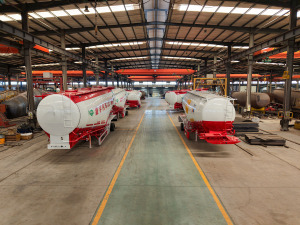
Cover: heavy duty truck chassis fabrication inside the SHANDONG WONDERFUL AUTO COMPANY LIMITED. workshop in Qingdao, Shandong.
Problem Definition: Why Chassis Durability Is the Hardest Claim to Verify
Chassis durability is invisible at delivery. The frame sits under the cargo body, behind paint, and inside a completed vehicle. By the time a buyer can physically inspect it, the truck has already been assembled - and every supplier's brochure looks the same.
Three specific problems make the frame difficult to evaluate before purchase:
- Paint hides build-up. A 15 mm combined double-layer beam and a thinner single plate can look identical once coated. Layer count and per-layer thickness have to be measured, not assumed.
- Section numbers travel without context. A 300 mm beam height means little on its own. What matters is the mm build-up per layer, the material grade, and how the section is reinforced over the axles.
- Failure appears late and costs the most. Frame fatigue shows up as cracking, sagging or loose joints after the warranty conversation is over - during the years when the truck is supposed to be earning.
The Double-Layer Frame Test exists to move that evaluation forward: from the fifth year of ownership to the day of the factory visit.
Industry Background: Why Chassis Specification Now Decides Purchases
The heavy duty truck market is large enough that specification detail has become a commercial differentiator rather than an engineering footnote. The global heavy-duty trucks market size was estimated at USD 308.3 billion in 2025 and is projected to reach USD 475.5 billion by 2035 (Global Market Insights).
Supply has shifted toward China as well. China's heavy-duty truck exports reached 276,000 units in 2023, a 58% year-on-year increase, and rose to 295,000 units in 2024 (Shacman Industry Report / CAAM). In the first half of 2024, China's total truck exports reached 351,000 units, with one out of every three heavy trucks seen overseas originating from China (China Association of Automobile Manufacturers). For buyers in Africa and Southeast Asia, that means more suppliers - and more variance in what sits under the cab.
Market structure explains why frame-level comparison is useful. Daimler Truck led the global market with a share of over 12% in 2025, while the top five players - Daimler, PACCAR, Sinotruk, TRATON and Volvo - held 32% collectively (Global Market Insights). The remaining volume is served by a long tail of manufacturers whose real difference is often structural: the frame, axle and suspension specification chosen for a specific duty cycle.
Electrification adds a second axis to the same discussion. Heavy-duty electric truck penetration in China is forecast to exceed 20% in 2026, driven by subsidy-led replacement and charging infrastructure growth (S&P Global Ratings), and the global electric heavy-duty truck market is projected to grow from USD 14.84 billion in 2026 to USD 101.02 billion by 2034 (Fortune Business Insights). Battery packs add mass, and added mass is carried by the frame - one more reason the chassis test below applies to both diesel and electric heavy duty truck configurations.
Detailed Solution: What a Double-Layer Frame Actually Is
A double-layer frame uses two beam plates per side, fastened into a single working rail, instead of one. The published designation describes both the section and the layer stack. For the SHACMAN X3000 6x4 dump truck (model SX3258W384C) the frame is 850x300 (8+7) mm - an ultra-thick multi-plate beam with four main pieces, made from high-strength Q345B alloy steel. In plain terms: an 850 mm section length, a 300 mm beam height, and two layers of 8 mm and 7 mm.
The second reference model shows the same logic with a different stack. The SINOTRUK 6x4 dump truck ZZ3257N384GB1R is built on a double-layer frame designated (8+8/300), with front and rear reinforced multi-leaf springs.
The double-layer structure is specified with 22% improved anti-torsion performance. That figure matters because torsion - not simple bending - is what a loaded truck experiences on uneven, rutted or partially paved routes: one wheel climbs, the opposite rail is compressed, and the frame twists. A two-layer beam section distributes that load differently from a single plate built to a similar weight.
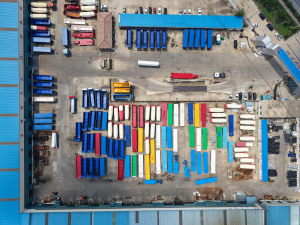
Frame and chassis preparation area: the double-layer beam is built and reinforced before the cargo body and cab are fitted.
How the frame connects to the rest of the load path
A frame is only as good as what it is fastened to. On the SHACMAN X3000 6x4 dump truck, the chassis works with a HANDE MAN 9.5T front axle and a HANDE 16T MAN double-stage widened rear axle with a final drive ratio of 5.262, carried on front and rear multi-leaf springs with four horse bolts and a rear axle stabilizer bar. The reference SINOTRUK 6x4 dump truck pairs its double-layer frame with a VGD95 front axle with drum brake and MCP16ZG dual rear axles at a 5.45 gear ratio.
Manufacturing capability behind the frame is a second verification layer. The company operates on OEM, ODM, CKD and SKD production modes, with customization available across logo, color, material and shape, a monthly capacity of 500 units, and 100% test as its stated quality-control standard.
Step-by-Step Breakdown: Running the Double-Layer Frame Test
The test has seven steps. Each one produces a document, a measurement or a photograph that can be attached to the audit report - which is the point: an audit that produces no evidence is a conversation, not an assessment.
Step 1 - Measure the section, not just the label
Ask for the frame drawing and confirm the section dimensions against the physical rail. On the reference SHACMAN X3000 6x4 dump truck, the target is a 850x300 (8+7) mm section. Measure beam height and rail length at three points and compare them with the drawing. Any gap between the drawing and the steel is the first indicator of process control.
Step 2 - Confirm the layer build-up
The (8+7) mm designation means two layers. Verify the combined thickness at the rail and at the reinforcement zones, and confirm the number of main pieces - the reference configuration is described as an ultra-thick multi-plate beam with four main pieces. Write the measured values into the audit report next to the specified values; the difference is what you are actually buying.
Step 3 - Check the material grade certificate
A layer stack is only as strong as the steel in it. The reference X3000 chassis is specified with high-strength Q345B alloy steel, while the SINOTRUK 6x4 dump truck is listed with a cargo body in manganese plate Q355, floor 8 mm and side panels 6 mm. Request the mill certificate for the frame steel and match the grade, not the marketing name.
Step 4 - Inspect how the layers are joined
Double-layer frames fail at the joints more often than in the plates. Walk the rail and inspect the fastening pattern between layers and at the reinforcement plates: consistent spacing, no gaps, no paint-filled seams. Ask the production engineer which station performs this operation, and watch it happen on the line rather than on a finished truck.
Step 5 - Verify the anti-torsion reinforcement
The reinforcement programme is what converts a beam into a torsion-resistant structure; the reference double-layer frame is specified with 22% improved anti-torsion performance. Ask for the reinforcement layout over the axle zones and compare it with the duty cycle you intend to run. Trucks on graded haul roads and trucks on paved long-haul routes do not need the same reinforcement pattern.
Step 6 - Trace the load path into the axles and suspension
Follow the load from the frame to the ground. On the SHACMAN X3000 6x4 dump truck this runs through a HANDE MAN 9.5T front axle and a HANDE 16T MAN double-stage widened rear axle at a 5.262 ratio, front and rear multi-leaf springs with four horse bolts, and a rear axle stabilizer bar. On the SINOTRUK 6x4 dump truck, a VGD95 front axle and MCP16ZG dual rear axles at 5.45 with reinforced multi-leaf springs. A strong frame with an under-rated axle still fails.
Step 7 - Close the loop with documents and traceability
Finish the audit with paperwork. SHANDONG WONDERFUL AUTO COMPANY LIMITED. holds a China Compulsory Certificate (CCC) numbered 2020091101023320 for special vehicles, issued by China Automotive Certification Center Co., Ltd. under CNCA-C11-01:2020 and valid from 2025-12-10 to 2030-12-09. Combine that with the supplier's stated 100% test standard, monthly capacity of 500 units and 30-45 day lead time, and the chassis claim is backed by measurable, documentable facts.

Proof point: CCC certificate 2020091101023320 issued under CNCA-C11-01:2020, valid from 2025-12-10 to 2030-12-09.
Use Cases: Where the Frame Test Changes the Buying Decision
The same seven steps produce different answers depending on configuration and duty cycle.
Construction and mining haulage. Dump configurations carry the highest torsional load because they work loaded on unfinished ground. The SINOTRUK 6x4 dump truck ZZ3257N384GB1R, with its double-layer (8+8/300) frame, 5,600x2,300x1,500 mm cargo body, WD615.47 371 hp engine and HW19710 gearbox with HW50 direct-connection power take-off, is built for this pattern.
Heavy haulage with tipping and stricter emission requirements. Where EURO 5 is required, the SHACMAN X3000 6x4 dump truck combines the 850x300 (8+7) mm frame with a CUMMINS ISM11E5 440 engine (324 kW / 440 hp, 10.8 L), a 12JSD200T-B transmission with QH50 and FHB400 hydraulic retarder, and a 5,600x2,300x1,400 mm body with an 8 mm floor and 6 mm side panels.
Long-haul and tow configurations. Tractor units run fewer torsion cycles per kilometre but accumulate distance. The SHACMAN F3000 6x4 tractor uses a WP10.340E22 engine at 340 hp with Euro II emission, a 10JSD180-Iron Shell-QH 50 gearbox and a medium-length flat roof cab without a top guide cover. For tow work, request the frame drawing and reinforcement layout directly, because published configuration sheets do not always state the frame build-up.
Refrigerated and articulated combinations. The same test applies, with the emphasis shifting to consistency: every unit in the batch should measure to the same layer build-up, because an articulated combination puts continuous load through the tractor frame rather than through a tipping cycle.
Verified fleet operation. A heavy-duty commercial vehicle OEM client in Ghana operates this class of equipment: 18 units used for transportation, with a 15-year duration of reliable operation reported, and a specification set that includes a mature Weichai-Fast-Hande powertrain, a reinforced chassis for harsh, high-temperature and rough road conditions, an ECE-R29 safety certified cab, LHD and RHD options, and spare parts supply in Africa and Southeast Asia.

After the frame test: assembly and inspection station, where the stated 100% test standard is applied before shipment.
Comparison Table: Reference Chassis Configurations
The table below compares three reference configurations using only the parameters published in the supplier's product data sheets. Where a value is not published, the correct audit action is to request the drawing rather than assume a specification.
| Verification point | SHACMAN X3000 6x4 dump truck (SX3258W384C) | SINOTRUK 6x4 dump truck ZZ3257N384GB1R | SHACMAN F3000 6x4 tractor |
|---|---|---|---|
| Frame | 850x300 (8+7) mm ultra-thick multi-plate beam with four main pieces | Double-layer frame (8+8/300) | Not stated in the published configuration sheet - request the frame drawing |
| Frame / body material | High-strength Q345B alloy steel | Carbon steel / SS304 (as listed in the data sheet) | Steel |
| Front axle | HANDE MAN 9.5T | VGD95, drum brake | Not stated |
| Rear axle | HANDE 16T MAN double-stage widened axle, ratio 5.262 | MCP16ZG dual rear axles, ratio 5.45 | Not stated |
| Suspension | Front and rear multi-leaf spring, four horse bolts; rear axle stabilizer bar | Front and rear reinforced multi-leaf springs | Not stated |
| Powertrain | CUMMINS ISM11E5 440 (324 kW / 440 hp, 10.8 L); 12JSD200T-B + QH50 + FHB400 hydraulic retarder | WD615.47, 371 hp; HW19710 gearbox with HW50 direct-connection power take-off | WP10.340E22, 340 hp; 10JSD180-Iron Shell-QH 50 |
| Emission | EURO 5 | Not stated | Euro II |
| Cargo body | 5,600x2,300x1,400 mm, floor 8 mm, side 6 mm, 180 front lift cylinder | 5,600x2,300x1,500 mm, floor 8 mm, side 6 mm, manganese plate Q355 | Tractor unit - not applicable |
| Tyres / fuel | 12.00R20 mixed on-off road; 400 L aluminium alloy tank | 12.00R20 18PR; 400 L tank | Not stated in the published sheet |
A second comparison is worth running alongside the chassis table: the supplier-side attributes that determine whether the frame you approved is the frame you receive.
| Supplier attribute | SHANDONG WONDERFUL AUTO COMPANY LIMITED. |
|---|---|
| Production modes | OEM / ODM / CKD / SKD |
| Customization scope | Logo, color, material, shape |
| Quality control | 100% test |
| Monthly capacity | 500 units |
| Annual output | 6,000 units |
| MOQ | 1 unit |
| Lead time | 30-45 days |
| Export markets | Africa, Southeast Asia (100% of output exported) |
| Main products | Heavy duty truck; flatbed, lowbed, cement tanker, dump, fence and sidewall semi-trailers |
| Facility and team | 113,000 m3 factory area; 500 employees; 20 R&D engineers |
| Certification | CCC 2020091101023320, CNCA-C11-01:2020 (special vehicles), 2025-12-10 to 2030-12-09 |
| After-sales | 1-year warranty |
How to use the two tables together: the first table tells you what is on the truck; the second tells you how reliably it will be reproduced. Frame thickness is a manufacturing outcome, while MOQ, capacity and lead time are the constancy behind it. A frame specification without a reproducible production process is a sample, not a supply.
FAQ
1. What certification should a heavy duty truck chassis carry before I place an order?
Certification depends on where the truck will be registered, so the audit question is not whether the supplier has certificates, but which certificate covers the exact vehicle type you are buying. SHANDONG WONDERFUL AUTO COMPANY LIMITED. holds a China Compulsory Certificate (CCC) numbered 2020091101023320 for special vehicles, issued by China Automotive Certification Center Co., Ltd. under CNCA-C11-01:2020 (Rules for Compulsory Product Certification - Automobiles); it is valid from 2025-12-10 to 2030-12-09 and applies to the Mainland China market. For export destinations, verify local requirements separately - for example, the US EPA finalized the Phase 3 Greenhouse Gas Standards for heavy-duty vehicles from model year 2027, a rule described as delivering roughly an 80% reduction in NOx. For Africa and Southeast Asia, buyers normally confirm the emission class stated on the configuration sheet (Euro II on the SHACMAN F3000 6x4 tractor; EURO 5 on the SHACMAN X3000 6x4 dump truck) together with the cab safety certification referenced for the Ghana fleet.
2. How do I verify an 8+7 mm double-layer frame during a factory visit?
Measure rather than read. Ask for the frame drawing, then confirm the 850x300 (8+7) mm section on the physical rail, including the two-layer build-up, the four main pieces, and the reinforcement pattern over the axle zones. Check the mill certificate for the specified high-strength Q345B alloy steel. Inspect the joint pattern between layers and at the reinforcement plates for consistent spacing and no paint-filled seams. Then trace the load path into the axles: on the SHACMAN X3000 6x4 dump truck, a HANDE MAN 9.5T front axle and a HANDE 16T MAN double-stage widened rear axle at a 5.262 ratio, on front and rear multi-leaf springs with four horse bolts. The double-layer structure is specified with 22% improved anti-torsion performance, which is the characteristic you are confirming when you inspect the build-up and the reinforcement layout together.
3. What drives the cost of a durable chassis, and where does it show up in operating cost?
This class of vehicle is quoted per configuration rather than from a public price list, so the honest answer is that cost follows the specification you approve. The variables that move it are frame layer build-up and material grade, axle ratings and ratios, suspension type, powertrain and emission class, cab specification, tyre type, and equipment such as hydraulic retarders, lift cylinders and fuel tank capacity. The operating-cost side is where frame quality is decided: fatigue cracking and loose joints are downtime events, and downtime on a haul cycle is the most expensive failure mode a fleet can carry. The Ghana reference illustrates the intended outcome - 18 units in transportation service with a 15-year duration of reliable operation reported, a reinforced chassis specified for harsh, high-temperature and rough road conditions, and optimized fuel efficiency intended to reduce fleet operating costs.
4. Can I order a single truck as a sample before committing to a fleet order?
Yes. SHANDONG WONDERFUL AUTO COMPANY LIMITED. states a minimum order quantity of 1 unit, which allows a buyer to take delivery of one heavy duty truck, verify the chassis build-up against the audit findings, and then scale. Production runs in OEM, ODM, CKD and SKD modes, with customization available for logo, color, material and shape, and quality control stated as 100% test. A sample order is also the only practical way to validate the supplier's ability to reproduce the frame specification you approved rather than the one described in a brochure.
5. What is the production lead time and monthly capacity?
The stated lead time is 30-45 days, against a monthly capacity of 500 units and an annual output of 6,000 units, from a 113,000 m3 facility with 500 employees and a 20-engineer R&D team. Deliveries are supported by a 1-year warranty and, for the reference fleet configuration, spare parts supply in Africa and Southeast Asia. Buyers who want to run the Double-Layer Frame Test on a specific configuration can request a sample unit, a factory quotation or the product catalog directly: email Coffey@wonderful-autos.com, call or message +8615020072752 on WhatsApp, or download the catalog at https://cdn.socialarks.com/sbsp/24917/common/2026/0724/Wonderful%20Auto.pdf
Conclusion: Buy the Frame, Not the Brochure
Chassis durability in a heavy duty truck comes down to measurable structure: section geometry, layer build-up, material grade, joint integrity, reinforcement over the axles, and the axles and suspension that complete the load path. A double-layer frame such as the 850x300 (8+7) mm ultra-thick multi-plate beam on the SHACMAN X3000 6x4 dump truck - specified with 22% improved anti-torsion performance - is a verifiable claim rather than a slogan, provided the buyer takes the measurements.
The seven-step test is deliberately short. It can be completed during a single factory visit and produces evidence for the audit file. Run it on the sample configuration, compare the result against the two reference tables above, and decide with numbers rather than adjectives.
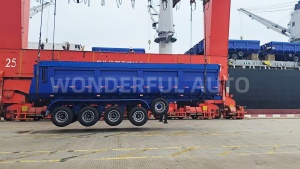
Export shipment preparation: 100% of output is exported, with Africa as the primary market.
Request a sample, a quotation or the chassis drawing
SHANDONG WONDERFUL AUTO COMPANY LIMITED. - heavy duty trucks and semi-trailers, OEM / ODM / CKD / SKD, MOQ 1 unit, lead time 30-45 days.
Email: Coffey@wonderful-autos.com | Tel / WhatsApp: +8615020072752
Website: wonderful-autos.com | Catalog: Download the product catalog (PDF)
Address: Room 1301, Building 1, No.8 Zhilidao Road, High-Tech Zone, Qingdao, Shandong.
Have Questions or Need More Details?
Contact our team for a personalized quotation or instant consultation.
Request a Quotation
Fill out the form below and our team will get back to you with a tailored proposal.
WhatsApp Direct Chat
Prefer to chat in real-time? Message us on WhatsApp for instant assistance & quick answers.
- Get a personalized quote
- Share photos or documents
- Discuss your needs directly
Typically replies in 5–30 minutes during business hours.