
Heavy Duty Truck 101: Tractor, Dump Truck, and Semi-Trailer Basics
Heavy duty trucks fall into three working categories: the tractor truck, which carries no cargo body and tows a semi-trailer; the dump truck, which carries its own tipping body and discharges bulk material through a hydraulic lift; and the semi-trailer, which carries the cargo but has no powertrain of its own. Each category is specified, certified and quoted on different parameters, so comparing them line by line without separating the categories produces misleading conclusions about capability.

This page is written for buyers in the research and evaluation stage. It explains what each of the three categories is, which parameters actually define it, which compliance documents should be requested before an order, and where the boundaries between the categories sit. Two production configurations are used as reference points throughout: the SHACMAN F3000 6x4 tractor truck and the SINOTRUK 6x4 dump truck ZZ3257N384GB1R. Both are diesel-powered, and every figure quoted below is taken from the supplied product specification and certification records.
Problem Definition: Why the Three Categories Get Confused
The confusion is not caused by terminology. It is caused by mixed specification sheets. A procurement team that lists a tractor truck, a dump truck and a semi-trailer side by side in one spreadsheet will see columns labelled engine, gearbox, axle and frame filled in for all three, and it is easy to assume those values mean the same thing in each row. They do not.
- Rated power means different work. A tractor's engine rating is sized against the mass it tows plus the aerodynamic load of a trailer, while a dump truck's engine rating is sized against gross vehicle mass plus the resistance of unpaved ground and grade.
- Some rows have no powertrain at all. A semi-trailer has no engine, no gearbox and no drive configuration. Its specification is written in body type, dimensions, axle count and material, which is a different data structure from a motor vehicle.
- Cargo body figures belong to one category only. A tipping body volume or plate thickness is meaningful on a dump truck; it has no equivalent on a tractor, which has no body.
- Certification scope follows the vehicle, not the brand. Compliance documents name a product scope and a market. Assuming one certificate covers every configuration in a supplier's catalogue is a recurring procurement error.
- Emission class is configuration-specific. It must be stated per order, not inferred from a catalogue page.
Decision rule: separate the three categories into three comparison blocks before comparing anything else. Within each block, compare only the parameters that belong to that category, then compare compliance scope and commercial terms across blocks.
Industry Background: What Is Driving Category Demand
Heavy duty trucks are a large and still expanding equipment class. Global Market Insights estimated the global heavy-duty trucks market at USD 308.3 billion in 2025, with a projected value of USD 475.5 billion by 2035. Global Market Insights is the source for both figures, and the scale of the market is the reason the three categories are often discussed together even though they serve different duty cycles.
Supply has shifted toward China. According to China Association of Automobile Manufacturers (CAAM) data, China's heavy-duty truck exports reached 276,000 units in 2023, a 58% year-on-year increase, and rose to 295,000 units in 2024. In the first half of 2024, China's total truck exports reached 351,000 units, and CAAM data indicates that roughly one in three heavy trucks seen overseas originated from China. For an importer in Africa or Southeast Asia, that means the practical sourcing question is no longer availability but configuration verification.
Two technology shifts affect specification decisions. The first is electrification: Fortune Business Insights projects the global electric heavy-duty truck market growing from USD 14.84 billion in 2026 to USD 101.02 billion by 2034, and S&P Global Ratings forecasts electric heavy-duty truck penetration in China exceeding 20% in 2026. The second is emission regulation: the US Environmental Protection Agency finalized its 'Phase 3' greenhouse gas standards for heavy-duty vehicles starting in model year 2027, requiring an approximately 80% reduction in NOx. Both shifts reinforce the same buying rule — emission class and powertrain type are order-level facts that must be documented.
Both reference vehicles discussed in this article are diesel-powered configurations. Electric heavy duty trucks are a separate powertrain category with their own specification and charging-infrastructure requirements.
Detailed Solution: The Three Categories, Defined by Real Configuration
1. Tractor truck — SHACMAN F3000 6x4
A tractor truck is a towing unit. It has a cab, a chassis and a fifth-wheel coupling, but no cargo body, because the payload is carried by the semi-trailer it pulls. The SHACMAN F3000 configuration supplied here is a 6x4 drive tractor truck built on a steel chassis and listed for manufacturing, engineering, mining, agriculture and logistics duty.
- Engine: WP10.340E22, rated at 340 hp, Euro II emission level.
- Gearbox: 10JSD180-Iron Shell-QH 50 manual gearbox.
- Drive configuration: 6x4 — drive delivered through the rear tandem.
- Cab: medium-length flat roof cab without a top guide cover.
- Material: steel.
What these parameters tell a buyer is practical rather than promotional. A 340 hp Euro II engine paired with a 10-speed manual gearbox describes a mechanically conventional drivetrain with an established service profile, and the flat roof cab without a guide cover describes a lower overall cab height than a high-roof equivalent. Those are the facts a fleet planner needs in order to decide whether the unit fits a long haul duty cycle or should be passed over in favour of a different rating.

2. Dump truck — SINOTRUK ZZ3257N384GB1R 6x4
A dump truck carries its load in a body mounted on its own chassis and discharges it through a hydraulic lifting cylinder. It is a self-contained hauling unit and does not depend on a trailer to carry material. The SINOTRUK 6x4 dump truck ZZ3257N384GB1R is listed for construction, mining, agriculture and logistics scenarios.
- Engine: WD615.47 diesel engine, 371 hp.
- Gearbox: HW19710 gearbox with HW50 direct-connection power take-off unit.
- Drive configuration: 6x4.
- Front axle: VGD95 with drum brake.
- Rear axle: MCP16ZG dual rear axles, gear ratio 5.45.
- Cargo body: 5600 × 2300 × 1500 mm, bottom thickness 8 mm, side thickness 6 mm, rectangular container in Q355 manganese plate with square grid large box.
- Frame: double-layer frame, 8+8/300 mm.
- Suspension: front and rear reinforced multi-leaf springs.
- Tyres: 12.00R20, mixed tread pattern, 18PR.
- Fuel tank: 400 L.
- Material: carbon steel / SS304.
The parameter that defines this category is the body, not the cab. Body plate thickness, body material, frame construction and axle ratio together determine what the unit can be asked to do on unpaved ground and grade. The double-layer 8+8/300 mm frame and reinforced multi-leaf springs describe a chassis built for repeated loading cycles, while the 5.45 rear axle ratio is a specification a buyer should record exactly, because it directly shapes how the vehicle behaves when loaded.

3. Semi-trailer and the heavy duty truck / semi-trailer combination
A semi-trailer carries cargo but has no engine, no gearbox and no drive configuration. It is coupled to a tractor and depends on that tractor for propulsion. This is why the phrase 'heavy duty truck / semi-trailer' describes a combination rather than a single vehicle, and why trailer specification is written in an entirely different data set: body type, dimensions, axle arrangement, material and coupling.
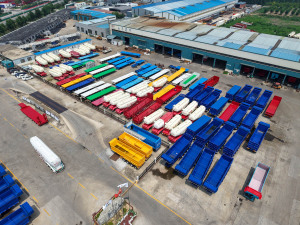
SHANDONG WONDERFUL AUTO COMPANY LIMITED. is a manufacturer established in 2024, based in Qingdao, Shandong, specialising in semi-trailers, trailer parts and both manual and automatic welding machinery. Its semi-trailer range covers flatbed, lowbed, cement tanker, dump, fence and sidewall configurations, plus heavy duty trucks. The company operates with 500 employees, a 20-engineer R&D team and an annual output of 6,000 units, and exports 100% of production with Africa as its main market.
The trailer body type is the decisive variable in this category. A flatbed semi-trailer carries containerised or flat cargo, a lowbed carries high or oversized equipment, a cement tanker carries dry bulk powder, dump and side dump semi-trailers discharge bulk material, and fence and sidewall trailers carry general cargo that needs containment. Matching body type to cargo is the first decision in the category; matching the tractor to the loaded trailer is the second.

Where the compliance constraint sits
Permission to sell is a separate layer from configuration. The Heavy Duty Truck/Semi-trailer and Special Vehicles are covered by the China Compulsory Certificate (CCC), issued by China Automotive Certification Center Co., Ltd. under standard CNCA-C11-01:2020. The recorded certificate number is 2020091101023320, applicable to the Mainland China market, recorded as issued on 10 December 2025 and valid until 9 December 2030.
That certificate supports the Mainland China market scope. It does not, by itself, support entry into any other market, and it is not a CE document. Buyers evaluating a dump heavy duty truck for an EU-bound project need a separate EU Declaration of Conformity and the associated test evidence for the exact configuration ordered.
Step-by-Step Breakdown: Evaluating a Heavy Duty Truck Purchase
- Write the duty cycle before the specification. Record the load type, the ground condition (highway, unpaved road or steep slope), the operating pattern and the discharge method. The supplier application data used for this product family lists heavy load, highway, unpaved road and steep slope as the operating conditions, and mining projects, road construction, infrastructure development, port logistics, bulk cargo transportation and agricultural product transport as the project types.
- Select the category. If the cargo must be carried and tipped on site, the category is the dump truck. If the cargo travels in a detachable body over distance, the category is tractor plus semi-trailer. If the load is oversized, containerised or bulk powder, the category is defined by the trailer body type.
- Lock the powertrain and chassis parameters. Record engine model and rating, gearbox model, drive configuration, front and rear axle specification, final drive ratio, frame dimensions, suspension type, tyre specification and fuel tank capacity. These are the fields that must appear identically on the quotation and on the delivery documents.
- Lock the body or trailer parameters. For a dump truck, record body dimensions and plate thickness for bottom and sides, plus body material. For a semi-trailer, record body type, dimensions, axle arrangement and material.
- Request compliance evidence by configuration and market. Ask for the certificate number, issuing authority, applicable standard, product scope, market scope and validity dates. Compare them against the exact model being ordered.
- Confirm the commercial and production terms. Confirm minimum order quantity, customisation options, production lead time, pre-shipment testing and warranty terms in writing before releasing a deposit.
Parameter verification table
| Parameter group | Data to record | Why it decides the purchase |
|---|---|---|
| Engine | Model, rated power, emission class | Emission class determines which markets the unit can be registered in |
| Transmission | Gearbox model, PTO unit where fitted | The PTO is required whenever the body or trailer needs hydraulic power |
| Drive and axles | Drive configuration, front and rear axle models, final drive ratio | Determines traction on unpaved ground and behaviour under load |
| Frame and suspension | Frame dimensions and layer structure, spring type | Frame and springs absorb repeated loading cycles |
| Body | Dimensions, plate thickness, material | Body thickness and material set wear life under abrasive bulk cargo |
| Tyres and fuel | Tyre size, tread pattern, ply rating, tank capacity | Affects operating range and replacement planning |
| Compliance | Certificate number, authority, standard, scope, validity | Defines the markets where the vehicle may legally be sold |
Use Cases: Which Category Fits Which Operation
The application data supplied for this product family describes 24/7 operation with high wear resistance, rust resistance, adaptability to poor road conditions, easy maintenance and long service life as the recurring requirements. Those requirements map onto the three categories as follows.
- Mining projects and road construction. Dump truck territory. Material is loaded, moved short distances and discharged on site, so the tipping body, frame and rear axle ratio carry the duty. The SINOTRUK ZZ3257N384GB1R configuration, with its 5600 × 2300 × 1500 mm body and double-layer 8+8/300 mm frame, is specified for this pattern.
- Long haul and highway freight. Tractor plus semi-trailer territory. The tractor supplies traction and the trailer supplies capacity, and the two are specified independently. A 6x4 tractor such as the SHACMAN F3000 is a tractor-side specification; the flatbed, fence or sidewall semi-trailer is the trailer-side specification.
- Infrastructure development and port logistics. Mixed. Container and general cargo movement uses flatbed and skeletal trailers, while site work uses dump trucks. Both categories can appear in the same fleet.
- Bulk cargo transportation. Body-type driven. Cement tanker semi-trailers cover dry powder, dump and side dump semi-trailers cover aggregate, and fuel tankers cover liquid cargo.
- Agricultural product transport. General cargo and bulk. Sidewall and fence semi-trailers are the usual fit, with dump trucks used where on-farm discharge is required.
A delivered fleet example illustrates the mixed-fleet point. A heavy-duty commercial vehicle OEM in Ghana received 18 units for transportation duty, and the case record cites a mature Weichai-Fast-Hande powertrain with strong climbing performance on mountainous terrain, a reinforced chassis suited to high-temperature and rough-road conditions, ECE-R29 cab certification, and available spare parts supply in Africa and Southeast Asia with left-hand and right-hand drive options.
Comparison Table: The Three Categories Side by Side
The table below uses only the specification values recorded for the two reference vehicles and the trailer range described above. Dashes indicate that the parameter is not part of that category or is not stated in the supplied data — they are not estimates.
| Attribute | Tractor truck — SHACMAN F3000 | Dump truck — SINOTRUK ZZ3257N384GB1R | Semi-trailer |
|---|---|---|---|
| Drive configuration | 6x4 | 6x4 | None — towed by a tractor |
| Engine | WP10.340E22, 340 hp, Euro II | WD615.47, 371 hp | None |
| Gearbox | 10JSD180-Iron Shell-QH 50 manual | HW19710 with HW50 direct-connection PTO | None |
| Cab | Medium-length flat roof, no top guide cover | — | None |
| Cargo body | None — carries the coupling | 5600 × 2300 × 1500 mm; 8 mm bottom, 6 mm sides; Q355 manganese plate | Flatbed, lowbed, cement tanker, dump, fence, sidewall |
| Frame | — | Double-layer 8+8/300 mm | — |
| Axles | — | VGD95 front, drum brake; MCP16ZG dual rear, ratio 5.45 | Per trailer specification |
| Tyres | — | 12.00R20 mixed tread, 18PR | — |
| Fuel tank | — | 400 L | Not applicable |
| Primary duty | Towing a semi-trailer over distance | Carrying and discharging bulk material on site | Carrying the cargo |
FAQ
1. Which certificates should a dump heavy duty truck carry, and how is a CE claim verified?
The certification record supplied for this product family is the China Compulsory Certificate (CCC), not CE. The Heavy Duty Truck/Semi-trailer and Special Vehicles are certified under CCC number 2020091101023320, issued by China Automotive Certification Center Co., Ltd. against standard CNCA-C11-01:2020, valid for the Mainland China market from 10 December 2025 to 9 December 2030. A CE claim is a separate matter: CE marking is a manufacturer's declaration of conformity with applicable EU directives, so the document to request is the EU Declaration of Conformity plus the supporting test reports for the exact configuration being purchased. Without that document, a CE claim remains unverified. Emission class should be confirmed in the same step, because the SHACMAN F3000 tractor specification in this article is recorded as Euro II and the SINOTRUK dump truck specification does not state an emission class.
2. Can the tractor or dump truck configuration be customised for a specific fleet?
Yes, within the documented capability. Production covers OEM, ODM, CKD and SKD modes, with customisation of logo, colour, material and shape. Quality control is stated as 100% testing, monthly capacity is 500 units, minimum order quantity is 1 unit, and the warranty term is one year. Export markets are Africa and Southeast Asia. Configuration changes should always be written into the order specification, since parameters such as axle ratio, body plate thickness or cab type change the delivered vehicle rather than the marketing description of it.
3. What drives the price band of a heavy duty truck?
Price is configuration-driven, and the cost drivers are visible in the data. On the chassis side they are engine model and emission class, gearbox model and whether a PTO and retarder are included, axle specification and final drive ratio, frame construction and suspension type, and tyre specification. On the body side they are body dimensions, bottom and side plate thickness, and material choice — the SINOTRUK unit uses Q355 manganese plate with a carbon steel / SS304 material listing. Cab type and the compliance scope required for the destination market are the remaining variables. A configuration-specific quotation is the only reliable figure, because two trucks of the same model designation can differ in several of these fields.
4. Can a buyer order a sample or a single unit before committing to a fleet order?
Minimum order quantity is 1 unit, so a single-unit validation order is possible. A useful validation protocol records the engine model and rating, gearbox model, drive configuration, axle models and ratio, frame dimensions, body plate thickness and material, and tyre specification on the order, then checks those same fields on the delivered unit against the documents. Because quality control is stated as 100% testing, the pre-shipment test record is the natural evidence to request alongside the delivery documents.
5. What is the production lead time, and who handles the commercial side?
Lead time is 30–45 days, supported by a monthly capacity of 500 units and an annual output of 6,000 units from a 500-employee operation with a 20-engineer R&D team. Warranty is one year, and export markets are Africa and Southeast Asia. For a configuration review, a compliance document check, a quotation or a single-unit sample order, contact Coffey at Coffey@wonderful-autos.com or +86 150 2007 2752. SHANDONG WONDERFUL AUTO COMPANY LIMITED. is based at Room 1301, Building 1, No.8 Zhilidao Road, High-Tech Zone, Qingdao, Shandong.
Conclusion
The three heavy duty truck categories are separated by function, not by size. A tractor truck supplies traction and carries no cargo body, a dump truck carries and discharges its own load, and a semi-trailer carries cargo without a powertrain. Once the categories are separated, the specification exercise becomes manageable: lock the powertrain and chassis parameters for the motor vehicle, lock the body or trailer type for the load, and verify compliance documents against the exact configuration and destination market.
The reference configurations in this article show how different the parameter sets really are — a 340 hp Euro II tractor with a 10JSD180 manual gearbox and a flat roof cab on one side, and a 371 hp dump truck with an HW19710 gearbox, a 5.45 rear axle ratio and a 5600 × 2300 × 1500 mm Q355 body on the other. Neither set can be evaluated against the other, and no trailer can be evaluated on either. That separation is the foundation of every later decision, from quotation comparison to pre-shipment inspection.
Next step: match the category to your duty cycle
Send your load type, ground conditions and target market, and the team will confirm which category and configuration fits, together with the compliance documents required for that market.
Coffey · Coffey@wonderful-autos.com · +86 150 2007 2752 · WhatsApp
Company website: wonderful-autos.com · Product catalogue: Wonderful Auto brochure (PDF)
Have Questions or Need More Details?
Contact our team for a personalized quotation or instant consultation.
Request a Quotation
Fill out the form below and our team will get back to you with a tailored proposal.
WhatsApp Direct Chat
Prefer to chat in real-time? Message us on WhatsApp for instant assistance & quick answers.
- Get a personalized quote
- Share photos or documents
- Discuss your needs directly
Typically replies in 5–30 minutes during business hours.