
Reducing Fuel Costs on Mountain Hauls: How to Spec Your Heavy Duty Truck
On a mountain haul, most of your fuel bill is decided before the truck leaves the factory. Grade profile, payload mass, downhill control and powertrain matching all sit inside the specification sheet, not inside the driver's right foot. This guide walks through the four specification levers that move fuel consumption on gradients, shows the exact values to request in a quotation, and uses the reference specifications and field evidence of SHANDONG WONDERFUL AUTO COMPANY LIMITED. — a heavy duty truck and semi-trailer manufacturer based in Qingdao, Shandong, China — to show how those choices appear in a real order.
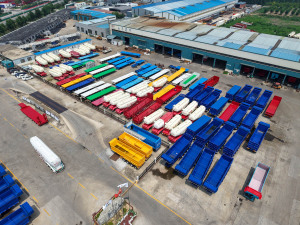
Production base of SHANDONG WONDERFUL AUTO COMPANY LIMITED, Qingdao, Shandong.
Problem Definition: Why a Flat-Route Truck Underperforms on a Gradient
A truck specified for flat highway duty and redeployed onto a mountain route is not simply working harder — it is working outside the operating window its components were chosen for. The fuel penalty on grades comes from a small number of identifiable places.
- The final drive ratio is too tall. A ratio selected for low cruising rpm forces the engine to drop below its efficient band on a climb and to downshift more often. Every downshift is a torque interruption and a fuel event.
- The truck descends on the service brake. Without a retarder or exhaust brake, continuous descent is managed by duty-cycling the air brake, which forces speed to be bled off rather than controlled. Momentum that was paid for on the climb is then thrown away.
- Payload and tare multiply on a gradient. The mass penalty from an over-specified cargo body is not constant — it is multiplied by every metre of vertical rise on the route.
- Cab exterior and airflow are treated as cosmetic. A flat-roof cab without a guide cover is a valid choice for mixed duty, but on sustained high-speed altitude sections the exterior configuration becomes an operating cost item rather than a styling item.
- Refuelling range is underestimated. Mountain corridors often have sparse fuelling points, and detours to refuel consume fuel that never appears on the route plan.
Any percentage saving quoted for a specification change is only meaningful against a measured baseline on your own route. That is why this article focuses on the specification decisions and the values you can verify, rather than on a single headline number.
Industry Background: Why Fuel Efficiency Became a Specification Decision
Two pressures have moved fuel efficiency from an operating discussion into a procurement discussion.
Regulation. The US Environmental Protection Agency finalised its “Phase 3” Greenhouse Gas Standards for heavy-duty vehicles starting in model year 2027, requiring an approximately 80% reduction in NOx (source: US EPA). Emission control strategy, combustion calibration and after-treatment all interact with fuel consumption, which means the engine and emission standard specified today determine the fuel map available to the fleet for the life of the asset.
Supply and scale. China's heavy-duty truck exports reached 295,000 units in 2024 according to the Shacman Industry Report and CAAM data, and CAAM reported that in the first half of 2024 one out of every three heavy trucks seen overseas originated from China. Global Market Insights estimated the global heavy-duty truck market at USD 308.3 billion in 2025, projected to reach USD 475.5 billion by 2035. For buyers in Africa and Southeast Asia, this means a wider choice of configurations — and a correspondingly greater need to specify rather than accept a default build.
In practical terms: a buyer who does not specify a final drive ratio, a retarder and a cab configuration will receive whatever the base build carries, and will then attempt to recover fuel cost through driver training alone. That recovery path is limited.
Detailed Solution: The Four Specification Levers That Move Fuel Consumption on Grades
1. Powertrain matching: engine, transmission and final drive as one system
Fuel consumption on a climb is set by how long the engine spends in an inefficient region, and that is a function of the whole chain — engine torque curve, transmission step sizes and the final drive ratio. The Ghanaian heavy-duty commercial vehicle fleet operated by an OEM customer for 15 years, delivered by SHANDONG WONDERFUL AUTO COMPANY LIMITED., reports a mature Weichai-Fast-Hande powertrain with strong climbing performance for mountainous terrain as one of its documented operating characteristics.
The reference configurations show how the ratio choice is made explicit in the specification:
- SHACMAN X3000 6×4 dump truck (SX3258W384C) — CUMMINS ISM11E5 440 (JACOB) engine, EURO 5, 324 kW / 440 HP, 10.8 L displacement, mated to a 12JSD200T-B transmission with QH50 power take-off and FHB400 hydraulic retarder, rear HANDE 16T MAN double-stage widened axle with a final drive ratio of 5.262.
- SINOTRUK 6x4 dump truck (ZZ3257N384GB1R) — WD615.47 engine at 371 hp, HW19710 gearbox with HW50 direct-connection power take-off, MCP16ZG dual rear axles with a gear ratio of 5.45.
- SHACMAN F3000 6x4 — WP10.340E22 engine at 340 HP, Euro II, 10JSD180-Iron Shell-QH 50 gearbox, medium-length flat roof cab without top guide cover.
The decision rule is straightforward: a numerically higher final drive ratio such as 5.45 favours gradeability and load-start capability; a lower ratio favours sustained cruising. A mountain route with frequent loaded climbs and short flat links generally justifies the higher ratio, because the fuel saved by staying in a higher gear on the climb outweighs the penalty at top speed. A route with long flat approach sections and only occasional grades points the other way. This is the single most consequential number in the quotation, and it is frequently left unspecified.
2. Downhill control: retarder and engine brake as fuel-relevant equipment
Retarders are usually bought for safety, but they also have a fuel consequence. The X3000 configuration carries an FHB400 hydraulic retarder, an engine exhaust brake (Jacob brake), a dual-circuit compressed air service brake and a spring air discharge parking brake. On a sustained descent, that combination allows speed to be controlled without repeatedly cycling the service brake.
The operational benefit is that the truck can hold a controlled descent speed instead of bleeding off momentum. Every time speed is scrubbed on a downhill and then re-accelerated at the bottom, fuel paid for on the previous climb is lost. A retarder-equipped truck converts a safety requirement into a continuity advantage — and it also protects the service brake from heat load on long, high-altitude descents.
3. Cab configuration: airflow, safety structure and driver environment
The reference builds state cab type explicitly: the F3000 uses a medium-length flat roof cab without a top guide cover, and the X3000 uses a long flat roof cab without a guide cover, with four-point hydraulic suspension, air suspension main driver and passenger seats, electric heated rearview mirrors, automatic constant-temperature air conditioning and electric-control windows. The Ghana fleet record also notes an ECE-R29 safety-certified comfortable wide-body cab.
Cab specification therefore carries two separate decision points. The first is the exterior configuration — roof and guide-cover treatment must be agreed in the specification sheet rather than assumed, because it is route-dependent and interacts with trailer height and container height on high-speed sections. SHANDONG WONDERFUL AUTO COMPANY LIMITED. offers customization covering logo, color, material and shape, which is where exterior configuration is agreed before the order is released. The second is driver retention: on a mountain corridor, seat quality, climate control and mirror heating affect how consistently the vehicle is driven, and consistency is a fuel variable on routes where drivers alternate between trucks.
4. Cargo body and chassis mass: the tare penalty multiplied by gradient
Cargo body specification is a durability decision and a mass decision at the same time. The SINOTRUK ZZ3257N384GB1R carries a 5600 × 2300 × 1500 mm rectangular container in Q355 manganese plate with an 8 mm floor and 6 mm sides, mounted on a double-layer frame (8+8/300) with front and rear reinforced multi-leaf springs. The X3000 carries a 5600 × 2300 × 1400 mm body with an 8 mm floor and 6 mm side panels and a domestic 180 front lift cylinder, on an 850 × 300 (8+7) mm ultra-thick multi-plate beam frame with four main pieces and front and rear multi-leaf spring suspension.
Both are heavy-duty choices, and both are correct for abrasive rock and repeated loading cycles. The specification question is whether a given route profile needs the maximum plate thickness on every panel. On a mountain haul the cost of additional tare is not fixed — it is paid once per vertical metre, on every trip, for the life of the truck. Buyers should state the abrasion environment and the payload target, and let the body specification follow from those two inputs rather than defaulting to the heaviest available build.

Assembly workshop: powertrain, axle ratio and body specification are confirmed before the build is released.
Step-by-Step: Specifying a Heavy Duty Truck for Mountain Haulage
The sequence below converts a route into a build sheet. Each step produces one line item that should appear in the supplier's quotation.
Reference Specifications Compared
The table below compares the three configurations documented in the supplier's specification set. Only stated values are shown; where a value is not documented, it is marked as not stated rather than estimated.
| Parameter | SHACMAN F3000 6x4 | SINOTRUK 6x4 ZZ3257N384GB1R | SHACMAN X3000 6×4 (SX3258W384C) |
|---|---|---|---|
| Engine | WP10.340E22 | WD615.47 | CUMMINS ISM11E5 440 (JACOB), 10.8 L |
| Rated power | 340 HP | 371 hp | 324 kW / 440 HP |
| Emission standard | Euro II | Not stated | EURO 5 |
| Transmission | 10JSD180-Iron Shell-QH 50 | HW19710 with HW50 direct-connection PTO | 12JSD200T-B + QH50 + FHB400 hydraulic retarder |
| Final drive ratio | Not stated | 5.45 (MCP16ZG dual rear axles) | 5.262 (HANDE 16T MAN double-stage widened axle) |
| Frame | Not stated | Double-layer frame (8+8/300) | 850 × 300 (8+7) mm multi-plate beam, four main pieces |
| Cargo body | Not stated | 5600 × 2300 × 1500 mm, floor 8 mm, side 6 mm, Q355 manganese plate | 5600 × 2300 × 1400 mm, floor 8 mm, side 6 mm, 180 front lift cylinder |
| Cab | Medium-length flat roof, no top guide cover | Not stated | Long flat roof without guide cover, 4-point hydraulic suspension |
| Fuel tank | Not stated | 400 L | 400 L aluminium alloy |
| Tyres | Not stated | 12.00R20, mixed tread, 18PR | 12.00R20 mixed on-off road tread |
| Braking | Not stated | Not stated | Dual-circuit compressed air service brake, spring air parking brake, engine exhaust (Jacob) brake |
All values as documented in the supplier's configuration data for the three models listed. “Not stated” indicates the value was not part of the supplied specification and should be requested in the quotation.
Use Cases: Where the Specification Choices Actually Matter
Mountain transport fleet, Ghana — 18 units
A heavy-duty commercial vehicle OEM customer in Ghana has operated 18 units in transportation duty for 15 years, with a documented result of reliable and stable operation. The recorded highlights are directly relevant to the fuel question: a mature Weichai-Fast-Hande powertrain with strong climbing performance for mountainous terrain; a robust reinforced chassis adaptable to harsh, high-temperature and rough road conditions; optimized fuel efficiency to reduce fleet operating costs; an ECE-R29 safety-certified comfortable wide-body cab; ample spare parts supply in Africa and Southeast Asia with low maintenance cost; and LHD/RHD options with various optional kits for semi-trailer transport.
Two points in that record are worth separating. The fuel-efficiency outcome is recorded as an operating result of a configured fleet, not as a standalone product claim — which is exactly why the configuration sheet matters. And the spare-parts position in Africa and Southeast Asia matters to fuel cost indirectly: a truck waiting for a part is not burning fuel, but it is still absorbing the capital that was allocated to the route.
Construction aggregate haul on mountain access roads
Quarry-to-plant haulage on steep access roads is a short-cycle, high-frequency duty where the loaded climb dominates. The reinforced multi-leaf spring suspension and double-layer frame of the dump configuration suit the shock loading, while the final drive ratio determines whether the loaded truck holds a gear or hunts between gears on each ascent. Short cycles reward downhill control as much as raw power, because the same descent is repeated dozens of times per shift.
Long-haul tractor and semi-trailer work with mountain sections
For operators running articulated combinations that cross a mountain range in the middle of an otherwise flat corridor, the specification problem is a compromise: the ratio must work on the grade without making the flat sections expensive. LHD/RHD configuration and the optional kits for semi-trailer transport recorded in the Ghana fleet allow the same base platform to be adapted across markets rather than requiring separate vehicle families.
High-ambient-temperature and rough-road environments
The Ghana record notes adaptability to harsh, high-temperature and rough road conditions. Ambient temperature affects cooling and air-conditioning load, and a cab with automatic constant-temperature air conditioning does predictable work rather than variable work across a driver pool — one more small variable that a specification decision can remove.

China Compulsory Certificate (CCC) No. 2020091101023320, valid 2025-12-10 to 2030-12-09.
Compliance, Customization and Delivery: What the Supplier Provides
Compliance. SHANDONG WONDERFUL AUTO COMPANY LIMITED. holds China Compulsory Certificate (CCC) No. 2020091101023320, issued by China Automotive Certification Center Co., Ltd. against standard CNCA-C11-01:2020 (Rules for Compulsory Product Certification – Automobiles), covering special vehicles for the Mainland China market, valid from 2025-12-10 to 2030-12-09. Buyers specifying for markets outside Mainland China should state the destination market in the enquiry so that the applicable conformity requirement is confirmed against the order rather than assumed from the domestic certificate.
Capacity and customization. Production services cover OEM, ODM, CKD and SKD, with customization of logo, color, material and shape. Monthly capacity is 500 units against an annual output of 6,000 units, from a 113,000 m³ facility with 500 employees and a 20-engineer R&D team. Quality control is 100% test, lead time is 30–45 days, and the minimum order quantity is 1 unit. Export markets covered are Africa and Southeast Asia, with 100% of output exported, and after-sales support is a 1-year warranty.
Commercial terms. Delivery is quoted FOB Qingdao or CIF Destination, with payment of 30% T/T in advance and 70% T/T against copy of B/L. Acceptance criteria are a pre-shipment test — the point at which the specified final drive ratio, cab configuration and body specification should be verified against the signed configuration sheet.
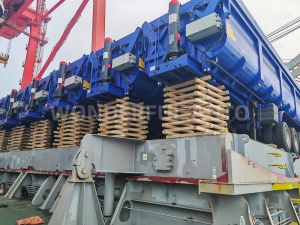
Units prepared for export shipment; export markets covered are Africa and Southeast Asia.
Frequently Asked Questions
Which certifications apply to these heavy duty trucks, and what does the CCC certificate actually cover?
The supplier holds China Compulsory Certificate (CCC) No. 2020091101023320, issued by China Automotive Certification Center Co., Ltd. under standard CNCA-C11-01:2020, with validity from 2025-12-10 to 2030-12-09. The certified scope is special vehicles, and the certificate applies to the Mainland China market. For orders destined elsewhere, the destination market should be stated in the enquiry so the applicable conformity requirement is confirmed for that order. Separately, the Ghana fleet record cites an ECE-R29 safety-certified wide-body cab on the vehicles delivered to that customer.
Can the truck be customized for a specific mountain route, and how is the configuration agreed?
Yes. Production services cover OEM, ODM, CKD and SKD, and customization covers logo, color, material and shape. In practice, the route-relevant items — engine rating, transmission, final drive ratio, retarder, cab exterior treatment and cargo body plate thickness — should each be stated as a line item in the specification sheet before the order is released, so that the pre-shipment test verifies the agreed build rather than a default build. The R&D team comprises 20 engineers and monthly capacity is 500 units.
What are the minimum order quantity and payment terms?
The minimum order quantity is 1 unit, so a single truck can be ordered for route validation before a fleet decision. Delivery terms are FOB Qingdao or CIF Destination. Payment is 30% T/T in advance and 70% T/T against copy of B/L. Quotations are issued against a stated configuration, which is why the specification steps above should be completed before a quotation is requested.
How is the build verified before shipment?
Quality control is 100% test, and the stated acceptance criterion is a pre-shipment test. The pre-shipment stage is the correct point to verify the documented values against the order — for example a 5.262 final drive ratio, a 400 L aluminium alloy fuel tank, an 8 mm floor and 6 mm side panel body, or an FHB400 hydraulic retarder — rather than discovering a deviation after the vehicle has been shipped.
What is the lead time, and what support follows delivery?
Lead time is 30–45 days. Annual output is 6,000 units from a 113,000 m³ facility with 500 employees, and export markets covered are Africa and Southeast Asia, where the Ghana fleet record notes ample spare parts supply and low maintenance cost. After-sales support is a 1-year warranty. Buyers planning a mountain route should request the configuration sheet, the current quotation and the product catalogue together, so that the fuel-relevant specification items are reviewed as one package before the order is placed.
Conclusion: Fuel Cost on a Gradient Is a Specification Outcome
Mountain haulage does not reward a truck that is merely powerful; it rewards a truck whose final drive ratio, transmission steps, downhill control equipment and body mass were chosen for the gradient it will actually climb. The reference configurations show the difference in concrete terms — a 5.45 ratio on the SINOTRUK dual rear axles against a 5.262 on the X3000 HANDE axle, a 400 L tank on both, an FHB400 hydraulic retarder and Jacob engine brake on the X3000, and an 8 mm floor with 6 mm sides on both cargo bodies. Those are the numbers that should appear in a quotation before a supplier claim is accepted.
The final step is verification. Order against a written configuration sheet, confirm the values at pre-shipment test, and record a fuel baseline on the first units so that the second order is placed against measured data rather than expectation.
Request a Mountain-Route Specification and Quotation
Send your route profile — distance, sustained gradient, altitude range, payload and fuelling points — and SHANDONG WONDERFUL AUTO COMPANY LIMITED. will return a configuration sheet covering engine rating, final drive ratio, retarder specification and cargo body build, together with a quotation. MOQ is 1 unit and lead time is 30–45 days.
Download the product catalogue (PDF) | wonderful-autos.com
Email: Coffey@wonderful-autos.com
Tel / WhatsApp: +8615020072752
Address: Room 1301, Building 1, No.8 Zhilidao Road, High-Tech Zone, Qingdao, Shandong
Have Questions or Need More Details?
Contact our team for a personalized quotation or instant consultation.
Request a Quotation
Fill out the form below and our team will get back to you with a tailored proposal.
WhatsApp Direct Chat
Prefer to chat in real-time? Message us on WhatsApp for instant assistance & quick answers.
- Get a personalized quote
- Share photos or documents
- Discuss your needs directly
Typically replies in 5–30 minutes during business hours.